New Book - “Dr. John Sarno’s Mind-Body Breakthrough” by Sarno Clinic
Chronic back pain is often treated as a structural problem. Yet for millions of people, scans show little that explain the ...
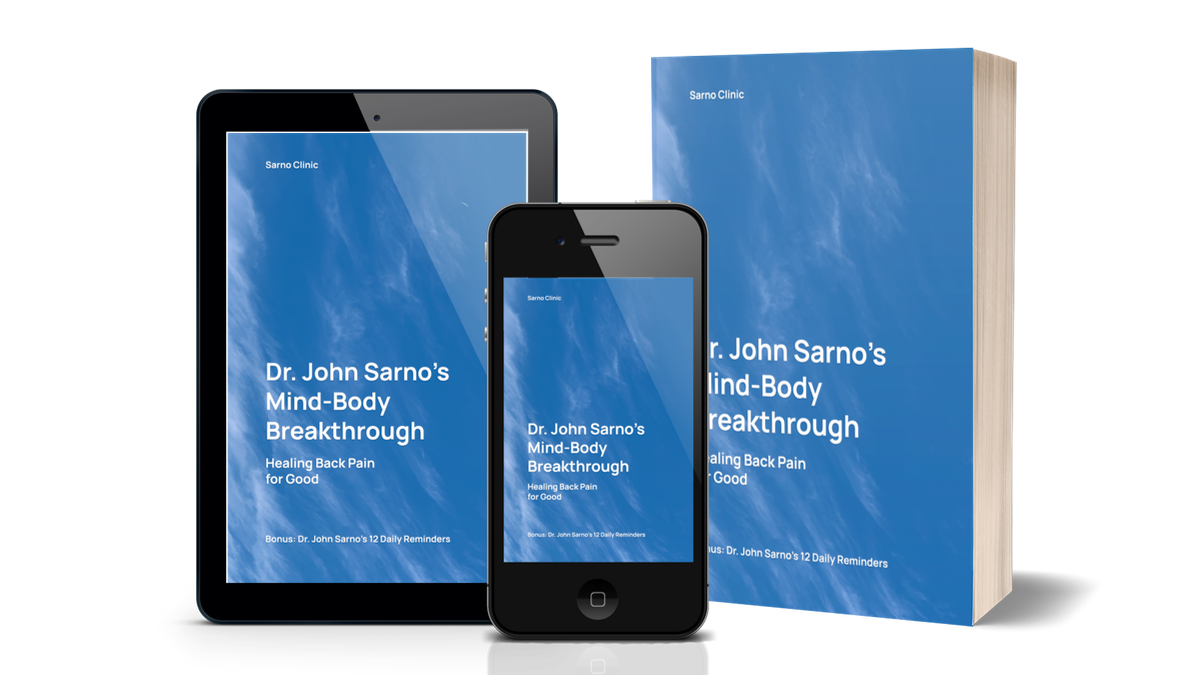
“Dr. John Sarno’s Mind-Body Breakthrough” Sarno Clinic Edition (Instant downloads for all devices) $9.95 - Buy now
“Dr. John Sarno’s Mind-Body Breakthrough” Kindle Edition (Instant download for Kindle) $9.95 - Buy now
“Dr. John Sarno’s Mind-Body Breakthrough” Audio Edition (Instant download) $14.95 - Buy now
“Dr. John Sarno’s Mind-Body Breakthrough” Paperback Edition $19.95 - Buy now
Sarno Clinic Edition gives you the best value with three file formats: EPUB, MOBI, and PDF — so you can read on any device. Securely pay with Visa, Mastercard, and more. Right after purchase, you’ll get download links for all three formats. We’ll also send you a thank you email with your download links and an option to generate an invoice.
“Dr. John Sarno’s Mind-Body Breakthrough: Healing Back Pain for Good”
Chronic back pain is often treated as a structural problem.
Discs, posture, degeneration, and biomechanics take center stage. Yet for millions of people, scans show little that explains the pain, and treatments fail to deliver lasting relief.
In “Dr. John Sarno’s Mind-Body Breakthrough: Healing Back Pain for Good,” a different explanation emerges.
Drawing on the pioneering work of Dr. John Sarno, this book explains how chronic back pain is frequently driven by the brain’s response to emotional stress, not physical damage. Known as Tension Myositis Syndrome (TMS), this mind-body process creates real pain through muscular tension, reduced blood flow, and heightened fear signaling.
This book explores:
- Why chronic back pain persists even when imaging looks “normal”
- How emotional suppression and personality traits contribute to pain
- How insight, education, and emotional awareness can reverse pain
- When structural treatments help, and when they do not
- Why fear and attention keep symptoms alive
Written in clear, professional language, this book bridges neuroscience, psychology, and modern pain science. Clinical insights, real-world examples, and practical guidance show how patients can reclaim movement, confidence, and control without surgery or endless treatment cycles.
Whether you are struggling with chronic back pain, exploring mind-body medicine, or working in healthcare, this book offers a grounded, evidence-informed path toward lasting recovery.
If you’ve been told your pain is permanent, unexplained, or something you must manage forever, this book challenges that belief and shows why understanding the mind-body connection can change everything.
“A revelation in understanding pain. Dr. Sarno’s work cuts through decades of confusion and fear to offer a clear, evidence-based path to recovery. This book proves that empowerment, not medication or surgery, is the real cure.” Emma Carlisle
“For anyone trapped in chronic back pain, this is the turning point. Dr. Sarno’s mind-body framework provides what conventional medicine has missed - a complete explanation that restores both movement and trust in your body.” Daniel Reyes
“Dr. Sarno’s ideas are as bold as they are compassionate. He challenges deeply held medical assumptions and replaces them with insight, clarity, and healing. This book gives people their lives back.” Grace Lin
“I’ve read hundreds of books on chronic pain, and very few have the credibility and impact of this one. It dismantles fear, restores confidence, and offers hope grounded in science.” Anna Whitaker
“Dr. Sarno shows that the key to healing isn’t found in pills or scans but in understanding the emotional roots of pain. This book is essential reading for anyone serious about recovery.” Theo Nguyen
“Elegant, logical, and deeply humane. This book will change how we think about pain forever. Dr. Sarno’s message remains as vital today as when he first introduced it - perhaps even more so in an age dominated by overmedicalization and misinformation. Every clinician and every patient should read this.” Nina Harper
“Dr. John Sarno’s Mind-Body Breakthrough” Sarno Clinic Edition (Instant downloads for all devices) $9.95 - Buy now
“Dr. John Sarno’s Mind-Body Breakthrough” Kindle Edition (Instant download for Kindle) $9.95 - Buy now
“Dr. John Sarno’s Mind-Body Breakthrough” Audio Edition (Instant download) $14.95 - Buy now
“Dr. John Sarno’s Mind-Body Breakthrough” Paperback Edition $19.95 - Buy now
Sarno Clinic Edition gives you the best value with three file formats: EPUB, MOBI, and PDF — so you can read on any device. Securely pay with Visa, Mastercard, and more. Right after purchase, you’ll get download links for all three formats. We’ll also send you a thank you email with your download links and an option to generate an invoice.
Sample - Chapter 1 Challenging fundamental assumptions
Chronic back pain has defied medical understanding for centuries.
People have long suffered, yet conventional treatments often fall short. Why do so many therapies, from medication to surgery, provide only temporary relief?
Dr. John Sarno confronted this question throughout his career. His investigation into history, psychology, and physiology revealed patterns overlooked by mainstream medicine.
A graduate of Columbia University College of Physicians and Surgeons, Dr. Sarno spent the majority of his career as a professor of rehabilitation medicine at the New York University School of Medicine and attending physician at the Howard A. Rusk Institute of Rehabilitation Medicine. His clinical work, spanning over five decades, focused primarily on patients with chronic musculoskeletal pain, particularly those suffering from back pain that had proven resistant to conventional medical interventions.
What distinguished Dr. Sarno from his contemporaries was not his medical pedigree or institutional affiliations, but his willingness to challenge entrenched assumptions about the nature of chronic pain itself.
Limitations of structural diagnosis
Western medicine traditionally emphasized structural explanations. Physicians focused on the spine, discs, and muscles as sources of pain. X-rays, CT scans, and MRIs became central diagnostic tools.
Treatment decisions relied heavily on imaging results. Surgeons repaired discs, physical therapists strengthened muscles, and patients often assumed that correcting a structural defect would end their suffering.
Despite technological advances, outcomes often disappointed. Some patients with severe spinal abnormalities reported no pain, while others with minor changes experienced debilitating discomfort. Dr. Sarno recognized that structural findings did not consistently correlate with symptoms. This discrepancy raised a fundamental question: could pain exist independently of tissue damage?
Early hints came from the study of psychosomatic medicine. Physicians in the 19th and early 20th centuries occasionally noted links between emotional distress and physical symptoms. Sigmund Freud suggested that repressed emotions could manifest as bodily complaints. William James explored the mind-body interaction, emphasizing how mental states influence physiological responses.
These insights remained peripheral within mainstream medical practice.
Cultural influences on chronic pain
Medical culture favored observable, tangible causes over invisible psychological processes. Anxiety, stress, and suppressed emotion proved difficult to measure and treat.
Chronic pain became medicalized through procedures, imaging, and pharmacology. Dr. Sarno challenged this orthodoxy, proposing that the brain could actively generate pain as a protective mechanism.
Even in the mid-20th century, physicians described “psychogenic” pain syndromes. Labels like “hysterical pain” or “functional disorder” appeared in case reports. Patients often felt dismissed or misunderstood. Dr. Sarno reframed the discussion, creating a systematic framework to explain chronic back pain as a mind-body condition, naming it Tension Myositis Syndrome, or TMS.
He believed that cultural attitudes contributed to prolonged suffering. Social norms encouraged emotional suppression, stoicism, and productivity. Suppressed feelings influenced physiology. Muscles tightened, circulation changed, and the brain produced pain to protect the individual from confronting unresolved stress.
Recognizing these patterns required both historical perspective and clinical observation.
Early observations and medical precedent
Dr. Sarno’s work did not arise in isolation. Historical accounts highlight physicians who observed similar mind-body interactions. William James described how emotion could affect bodily function.
Case reports of soldiers, laborers, and civilians noted pain without structural cause. Researchers documented functional limitations and muscular tension linked to stress. Yet these observations remained scattered and often anecdotal.
Medical textbooks occasionally acknowledged the influence of stress on recovery. Soldiers returning from combat exhibited unexplained pain, fatigue, and musculoskeletal symptoms. Civilian populations displayed similar patterns under occupational or social stress. Despite these insights, research remained fragmented and inconsistent. Psychosomatic medicine was peripheral, rarely incorporated into standard clinical practice.
By the mid-20th century, psychosomatic research expanded. Investigators studied the effects of personality traits, emotional suppression, and stress on health. Yet institutional acceptance lagged. Hospitals, insurance systems, and professional associations prioritized structural diagnoses and procedural interventions. Dr. Sarno faced resistance when he proposed that chronic back pain often originated in the mind.
He addressed skepticism with systematic observation. Patients reporting high stress, perfectionism, or suppressed anger frequently exhibited chronic musculoskeletal pain. These patterns emerged across professions, age groups, and symptom severity. Rather than dismissing anomalies, Dr. Sarno integrated them into a coherent theory: pain serves as a distraction from unresolved emotional tension.
Recognition of the mind’s role offered practical advantages. It provided an explanation for persistent pain resistant to conventional therapy. It offered hope for recovery without surgery, medication, or invasive procedures.
Patients could actively engage in their healing by understanding emotional triggers and changing their relationship with stress.
Cultural attitudes toward pain and emotion
Post-World War II society emphasized productivity, stoicism, and emotional control. Chronic pain often carried social and economic consequences.
Workers feared being perceived as weak or unproductive. Physicians reinforced structural explanations to maintain authority and align with societal expectations. Psychological explanations were frequently stigmatized.
Patients feared labels such as “hysterical” or “imaginary.” Many concealed emotional distress, which intensified muscle tension and prolonged pain. Dr. Sarno reframed emotional triggers as universal experiences rather than personal failings. Education became a central component of treatment, helping patients understand the physiological mechanisms behind TMS.
Medical education historically minimized the study of emotion. Courses emphasized anatomy, pathology, pharmacology, and surgery. Psychosomatic medicine existed on the periphery, with limited standardization. Dr. Sarno addressed this gap by offering clear, reproducible methods grounded in observation and patient education. Emotional awareness became as essential as structural assessment in his approach.
By integrating historical awareness with clinical observation, Dr. Sarno built credibility while avoiding unnecessary confrontation with entrenched institutions. Patients learned that their pain was real but not permanent or inevitable.
Insight became the cornerstone of recovery, echoing lessons from early psychosomatic pioneers while providing practical tools for daily life.
Tension Myositis Syndrome (TMS) in historical perspective
TMS reflects continuity with past psychosomatic observations while introducing innovation. Dr. Sarno synthesized the work of Freud, James, and others into a structured, clinically applicable framework.
Emotional tension, perfectionism, and stress emerged as measurable contributors to musculoskeletal pain. Treatment required more than reassurance; it required education, reflection, and insight.
Historical precedent underscores plausibility. Soldiers, industrial workers, and patients with chronic stress exhibited patterns consistent with TMS. Conventional medicine often treated only symptoms, leaving root causes unaddressed. Dr. Sarno’s innovation lay in transforming anecdotal observations into actionable, reproducible methods for patient recovery.
Clinical practice confirmed historical patterns. Patients resistant to standard treatment frequently improved once they recognized the emotional origin of their symptoms. Recovery followed a predictable trajectory: education, insight, and reduction of fear and tension.
Structural correction became unnecessary once emotional awareness was established.
Integration of mind-body principles into clinical practice
Education alone proved insufficient. Patients required guidance, reassurance, and structured reflection exercises.
Journaling, attention to emotional patterns, and gradual exposure to suppressed feelings became integral to therapy. Dr. Sarno documented patient progress meticulously, creating a record that combined anecdotal insight with systematic observation.
He recognized that cultural resistance and personal skepticism presented barriers. Medical culture favored structural explanations, while patients feared confronting emotions. Dr. Sarno navigated these challenges by emphasizing transparency, validation, and evidence.
Patients learned to view pain as a signal rather than a sentence, enabling active engagement in their own recovery.
Subsequent developments in psychosomatic medicine
By the 1970s and 1980s, research in psychosomatic medicine incorporated neurobiology, endocrinology, and stress physiology.
Studies demonstrated that chronic stress affects muscle tension, circulation, and pain perception. Dr. Sarno anticipated many of these findings, confirming the validity of his clinical insights.
Recognition of mind-body interactions remains incomplete, yet historical and contemporary research supports core principles of TMS. Emotional suppression, unresolved conflict, and chronic stress correlate with persistent musculoskeletal pain.
Dr. Sarno translated these principles into methods that patients could apply, producing consistent, long-term relief.
Understanding resistance and skepticism
Resistance to Dr. Sarno’s approach remains understandable. Acceptance requires confronting suppressed feelings, challenging cultural norms, and questioning biomedical assumptions.
Pain without structural cause challenges conventional logic. Yet decades of clinical observation demonstrate consistent results when patients embrace insight-based treatment.
Historical context clarifies this tension. Society stigmatized emotional vulnerability, medicine prioritized measurable structures, and research often dismissed psychosomatic phenomena. Dr. Sarno navigated these constraints by combining careful observation, patient education, and systematic documentation.
He validated patient experience while demonstrating a reliable path to recovery.
Patient experiences across history
Patients with chronic pain share remarkably consistent experiences. Sudden pain often follows periods of emotional stress, conflict, or pressure.
Conventional interventions provide temporary relief, yet symptoms persist. Dr. Sarno’s method addresses these factors directly, offering insight, reassurance, and structured strategies for resolution.
Patterns across populations reinforce TMS as a universal phenomenon. Soldiers, office workers, athletes, and retirees experience symptoms influenced by stress and suppressed emotion.
Historical consistency strengthens the credibility of the mind-body paradigm and informs contemporary application.
Chapter summary
Historical perspective clarifies why conventional medicine emphasized structural interventions and marginalized psychosomatic principles.
It highlights cultural attitudes, medical education, and societal pressures that shaped the understanding of chronic pain. Dr. Sarno synthesized these insights into a coherent, practical approach that empowers patients to confront emotional tension and resolve persistent pain.
Understanding history equips readers to approach TMS with curiosity and critical thinking. Dr. Sarno’s work extends historical observation into clinical application. It bridges the gap between psychosomatic theory and patient-centered treatment. Insight into emotional and psychological contributors transforms pain from a source of fear into a signal for reflection and recovery.
By situating TMS in historical context, this chapter establishes the foundation for the remaining text. Subsequent chapters examine theory, clinical methods, research evidence, and practical strategies.
Understanding the past allows readers to appreciate the innovation, rigor, and enduring relevance of Dr. Sarno’s mind-body approach to chronic back pain.
Enjoying this sample?
Buy your preferred edition to continue reading the full book.
“Dr. John Sarno’s Mind-Body Breakthrough” Sarno Clinic Edition (Instant downloads for all devices) $9.95 - Buy now
“Dr. John Sarno’s Mind-Body Breakthrough” Kindle Edition (Instant download for Kindle) $9.95 - Buy now
“Dr. John Sarno’s Mind-Body Breakthrough” Audio Edition (Instant download) $14.95 - Buy now
“Dr. John Sarno’s Mind-Body Breakthrough” Paperback Edition $19.95 - Buy now
Sarno Clinic Edition gives you the best value with three file formats: EPUB, MOBI, and PDF — so you can read on any device. Securely pay with Visa, Mastercard, and more. Right after purchase, you’ll get download links for all three formats. We’ll also send you a thank you email with your download links and an option to generate an invoice.